Email Kami :
info@labcompanion.cn
-

-

Hubungi Kami :
+86 18688888286

Electronic components including capacitors, resistors, connectors, sensors and integrated circuits serve as fundamental building blocks for all electronic devices. During service, these components are subjected to temperature variations. Divergent coefficients of thermal expansion among different materials generate cyclic thermal stress at solder joint interfaces, inside packages and material bonding interfaces under repeated temperature cycling. Long‑term stress may cause solder joint fatigue, package cracking and bond‑wire breakage. Such failures cannot be detected under ambient‑temperature tests and will only emerge under cyclic alternating thermal stress.
As a fundamental reliability validation method, temperature cycling test simulates temperature fluctuations during assembly, soldering and field operation, so as to evaluate mechanical and electrical integrity of components under alternating thermal stress. Specified by JEDEC JESD22‑A104, the standard for semiconductor device temperature cycling test, typical test conditions cover the range from ‑65 °C to +150 °C, with dwell time of 10‑15 minutes, temperature transition rate ≥15 °C/min and up to 1000+ test cycles.
Characterized by small dimensions, large test batch sizes and dense electrical interfaces, electronic components impose distinct requirements compared with complete‑unit or large‑assembly testing.
Lab Companion (Guangdong Hongzhan Technology Co., Ltd.), founded in 2005 in Dongguan, is a National High‑Tech Enterprise and Guangdong Specialized‑Refined‑Differential‑Innovative Enterprise with over 20‑year experience in environmental reliability test equipment.
The company operates under ISO 9001, ISO 14001, ISO 45001 and ISO 27001 management systems, and its products hold CE certification for EU markets. Three manufacturing bases are located in Dongguan, Kunshan and Chongqing. The Dongguan headquarters functions as the R&D center and main production site for standard chambers, covering a plant area of 27 286 m² with an annual output of approximately 1 000 environmental test chambers.
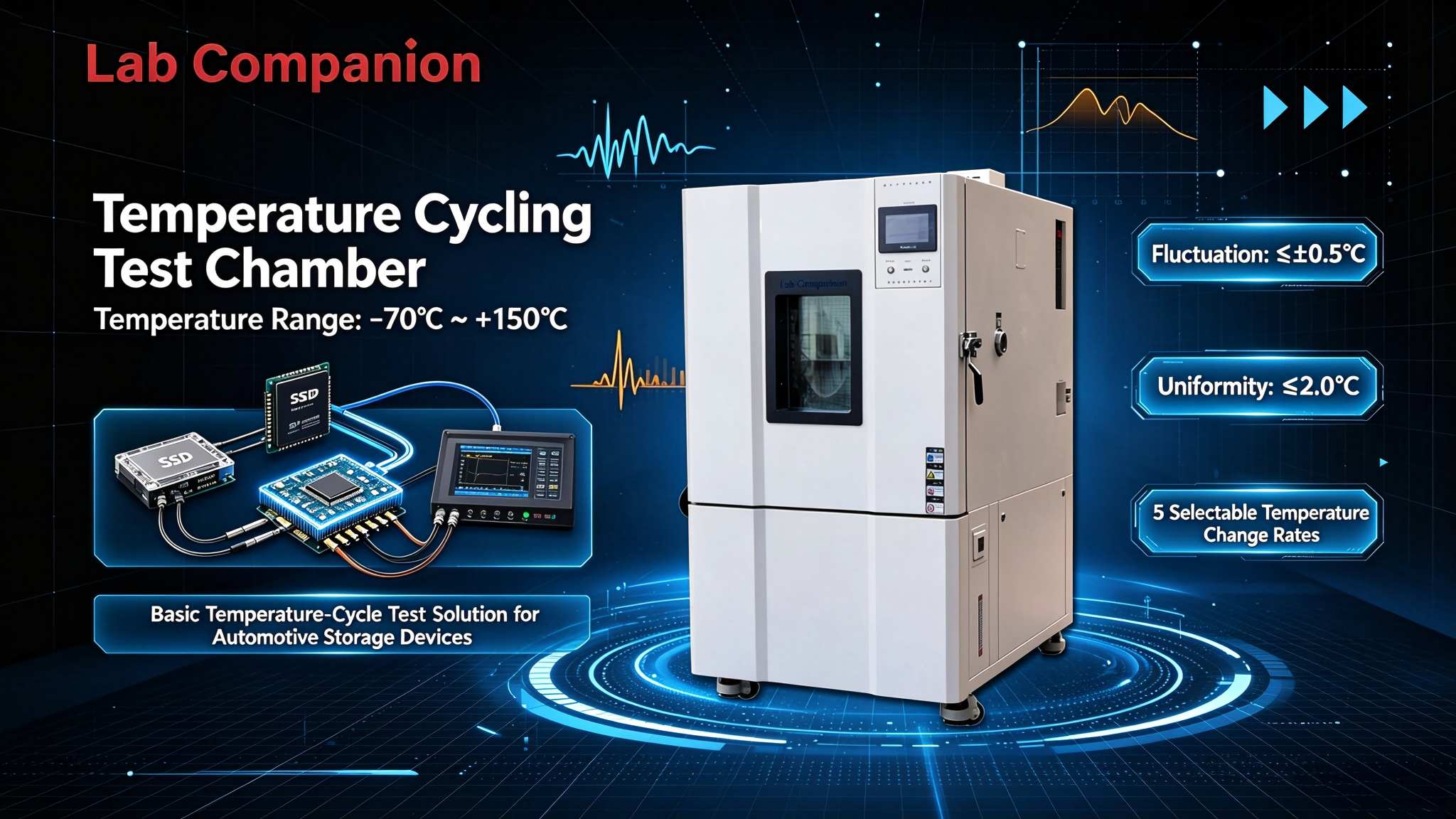
Standard temperature range: ‑70 °C ~ +150 °C, expandable up to +180 °C, fully covering temperature requirements defined in JESD22‑A104 and other mainstream semiconductor temperature‑cycling standards.
Available temperature ramp rates: 5 °C/min, 10 °C/min, 15 °C/min, 20 °C/min, 25 °C/min. Both linear and non‑linear temperature profiles are supported to meet ramp‑rate requirements of diverse test standards. Temperature fluctuation: ≤±0.5 °C; temperature deviation: ≤±2 °C.
Adopting dual‑air‑duct circulation together with multi‑point temperature sensor layout, the chamber achieves temperature uniformity ≤±2 °C under full‑load condition and ≤±0.5 °C under steady‑state conditions. This minimizes thermal‑stress discrepancy among components at different positions and suppresses data dispersion for batch testing.
The built‑in anti‑condensation system prevents dew formation on component pins and housings during low‑to‑high temperature ramp‑up, ensuring stable powered‑on on‑line testing. The observation window adopts multi‑layer conductive‑film tempered insulating glass with surrounding heating wires to eliminate frosting and fogging at low temperatures for clear visual sample inspection.
Standard chamber volumes: 34 L, 64 L, 100 L, 180 L, 340 L, 600 L, 1000 L. Custom non‑standard volumes from 80 L to 8000 L are available.
Models can be selected according to component package dimensions and batch sizes, with custom‑designed loading fixtures offered upon request. Extended multi‑channel temperature acquisition enables multi‑point chamber‑field monitoring. Dedicated cable ports are reserved for on‑line electrical‑parameter measurement. The chamber supports connection to host PCs and LIMS laboratory management systems for automatic recording and export of test curves and datasets.
Ramp‑rate requirements vary across component specifications. JESD22‑A104 specifies ≥15 °C/min for certain test conditions, while other industrial standards may require 5‑10 °C/min. Select ramp‑rate options strictly per applicable test specifications to avoid over‑specification or insufficient performance.
For large‑scale simultaneous testing, temperature uniformity is critical to test‑data credibility. Lab Companion chambers maintain ≤±2 °C uniformity under full‑load. For high‑precision applications, steady‑state performance can be further evaluated.
Powered‑on on‑line testing is common for electronic components. Define harness quantity and dimensions at the selection stage to confirm proper cable port sizing. Custom fixtures can be developed for specific component packages.
Determine required volume based on sample quantity per test run. Insufficient volume reduces throughput; excessively large volume increases difficulty in maintaining homogeneous thermal field. Standard‑volume models are preferred, and non‑custom solutions are applied for special test conditions.
Three core indicators dominate electronic‑component temperature‑cycling testing: temperature‑field uniformity, anti‑condensation capability and batch‑sample loading performance.
Lab Companion temperature cycling chambers deliver wide temperature range of ‑70 °C ~ +150 °C, multi‑step ramp rates from 5 °C/min to 25 °C/min and temperature fluctuation ≤±0.5 °C. Supported by dual‑air‑duct circulation and proven anti‑condensation technology, alongside flexible volume options ranging from 80 L to 8000 L and custom fixture services, our chambers provide complete reliability‑test solutions for semiconductors, passive components and PCB assemblies. Further technical proposals can be customized against your exact test conditions.


 Dapatkan Penawaran
 Jaringan IPv6 didukung