Email Kami :
info@labcompanion.cn
-

-

Hubungi Kami :
+86 18688888286

Real‑world operating conditions for electronic products never involve temperature stress in isolation. Automotive ECUs in engine compartments undergo drastic temperature swings while being subjected to high humidity from rain and snow. Energy‑storage battery systems may suffer internal condensation inside enclosures due to day‑night temperature fluctuations. Communication base stations deployed in coastal areas operate under prolonged alternating high‑temperature and high‑humidity conditions.
Temperature‑humidity coupling triggers multiple failure modes: high humidity accelerates electrochemical corrosion of metal pins; condensation on circuit boards under low‑temperature & high‑humidity conditions may cause short‑circuits; repeated thermal‑humidity cycles lead to aging and cracking of sealing materials. Combined temperature‑humidity cycling test serves as a standardized validation method to replicate such real‑world service conditions.
Temperature‑only cycling evaluates structural integrity and electrical stability under thermal stress. Humidity‑only testing focuses on material moisture absorption, insulation performance and corrosion susceptibility. Combined testing creates far more complex test conditions.
Saturated moisture‑holding capacity of air inside the chamber changes continuously with temperature. At low temperatures, air can hold far less water vapor. Poor control will result in unintended condensation or even frost formation on test samples. For instance, IEC 60068‑2‑30 defines cyclic damp‑heat testing with 12‑hour high‑temperature high‑humidity dwell followed by a 12‑hour cooling phase, intentionally generating condensation on specimen surfaces. This test imposes strict requirements on synchronized temperature‑humidity control of test equipment.
In international standards, IEC 60068‑2‑30 specifies the general method for cyclic damp‑heat tests to assess component and equipment performance under combined high‑humidity and temperature‑cycling conditions. IEC 60068‑2‑38 describes combined temperature‑humidity cyclic testing procedures.
For automotive electronics, ISO 16750‑4 defines dedicated temperature‑humidity cycling requirements for electronic units mounted at different vehicle locations. Corresponding specifications also apply to photovoltaic modules and energy‑storage systems in the new‑energy sector.
Compared with pure thermal cycling chambers, the key capability of combined temperature‑humidity chambers lies in synchronous humidity tracking along programmed temperature profiles during rapid temperature changes.
Take the cooling process from +85 ℃ / 85 %RH down to ‑40 ℃ as an example: saturated water‑vapor capacity drops sharply as temperature decreases. Without active humidity regulation, relative humidity inside the chamber will surge rapidly and produce unwanted condensation on samples. Excessive dehumidification, on the other hand, drives humidity below setpoints and causes non‑compliant test conditions.
The control system must calculate real‑time variation of saturated moisture capacity according to temperature change rate, and dynamically adjust humidification and dehumidification output to keep relative humidity within allowable tolerances.
Certain standards such as IEC 60068‑2‑30 require intentional condensation to evaluate product resistance to damp heat. However, excessive condensation in most other test scenarios may trigger sample short‑circuits and distorted test results and must be properly managed.
Equipment shall support configurable condensation‑control strategies, including cooling‑rate limitation, humidity‑setpoint adjustment, pre‑heating and defrost functions. Lab Companion units are equipped with standard anti‑unintended‑condensation logic to avoid unexpected dew formation on specimen surfaces during low‑temperature‑to‑high‑temperature ramps.
Conventional capacitive humidity sensors normally work reliably above 0 ℃. Below 0 ℃, frost buildup on sensor probes causes measurement drift and inaccurate readings. Test chambers shall adopt humidity‑measurement solutions with low‑temperature compensation or indirect calculation via wet‑bulb / dry‑bulb conversion for valid humidity evaluation under sub‑zero conditions.
Lab Companion is a national high‑tech enterprise and Guangdong‑province‑level specialized & sophisticated enterprise based in Dongguan, Guangdong, China.
The chamber adopts balanced temperature‑humidity control. Humidification is realized by steam generation from heated water pan. Dehumidification is achieved via vapor condensation on refrigerated evaporator surfaces. Throughout thermal cycling, the controller dynamically modulates humidification‑dehumidification output based on real‑time ramp rate and humidity deviation to maintain stable humidity tracking against temperature profiles.
Product link: https://www.labcompanion.cn/labcompanion_Product_2064188703.html?_v=1708161593
A 7‑inch color touch‑screen programmable controller with multi‑language interface supports multi‑segment profile editing. Users can configure ramp rates, humidity setpoints, dwell duration and cycle counts.
Test data and curves are recorded automatically. Historical logs can be exported via USB port. Communication interfaces are provided for LIMS integration to enable automatic data upload and report generation.
Major technical challenges of combined temperature‑humidity cycling testing lie in reliable humidity tracking during fast temperature transitions and controllable condensation management.
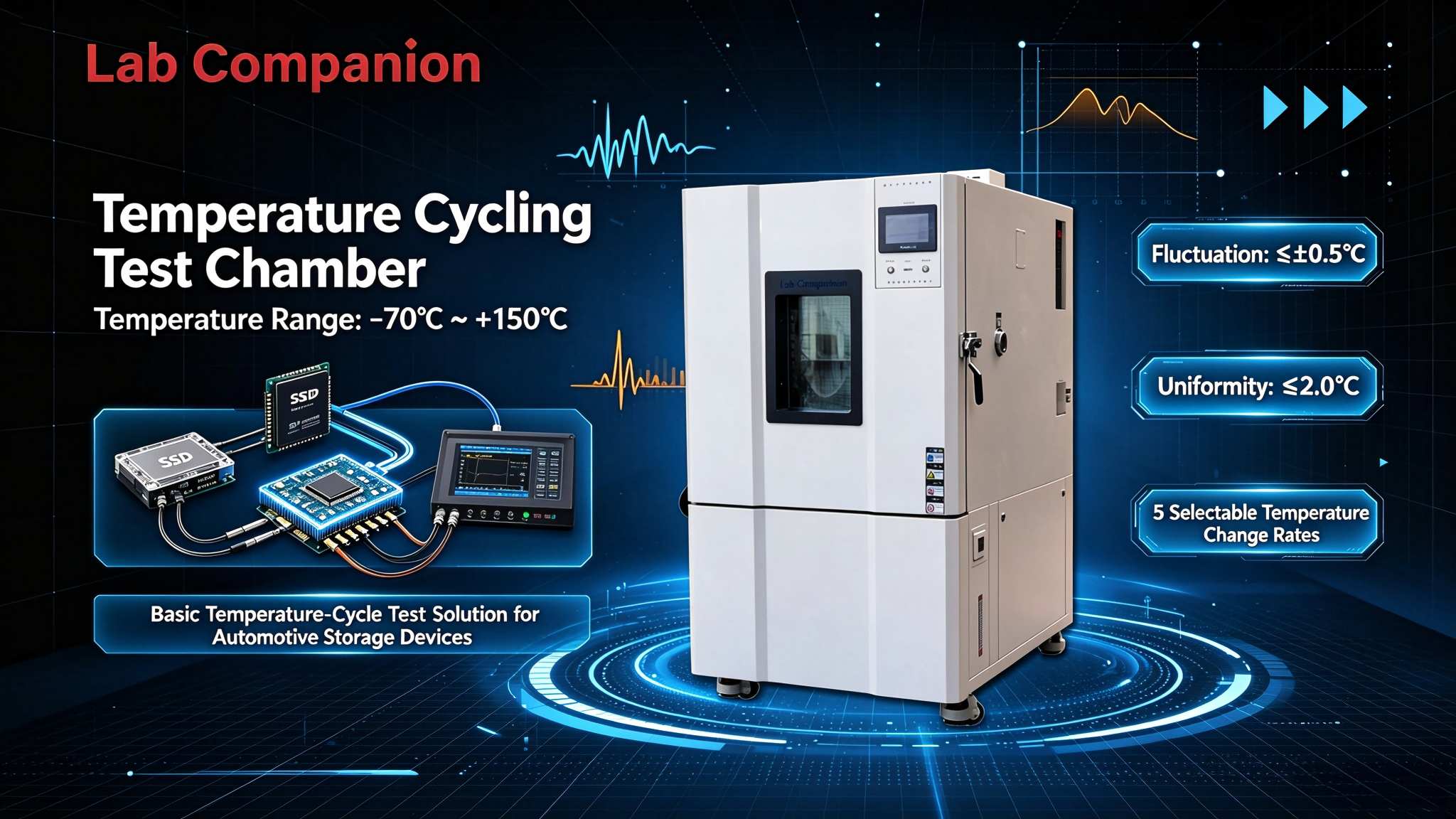
Lab Companion temperature‑humidity cycling test chambers deliver a proven solution for automotive‑electronics, new‑energy and industrial‑control customers, featuring wide temperature range of ‑70 ℃ ~ +150 ℃, humidity coverage from 25 %RH to 98 %RH, multiple ramp‑rate options from 5 ℃/min to 25 ℃/min, balanced temperature‑humidity control algorithm, flexible volume customization from 80 L to 8000 L, plus robust local manufacturing and delivery capabilities based in Dongguan, China. Further configuration adjustments can be made according to specific test standards and specimen conditions.


 Dapatkan Penawaran
 Jaringan IPv6 didukung