Email Kami :
info@labcompanion.cn
-

-

Hubungi Kami :
+86 18688888286

In 2026, the role of rapid thermal cycling chambers within China’s manufacturing sector is shifting. Once an optional piece of equipment primarily found in R&D laboratories, it has now become a standard workstation fixture for semiconductor packaging & testing, automotive electronics, optical communication modules, enterprise storage and other production lines.
As these chambers move into mass production workflows, the evaluation criteria for procurement have also evolved. Instead of merely checking the peak specifications listed on a datasheet, buyers focus on three core outcomes: consistent thermal cycling profiles across batches versus the first unit, lead times aligned with production changeover schedules, and test data acceptable for third-party audits. These three concerns are not about nominal parameters — they are about the manufacturing system behind those specifications.
The performance of a rapid thermal cycling chamber heavily relies on two integrated systems: the refrigeration circuit and the air duct system. The refrigeration circuit comprises compressors, evaporators, condensers, expansion valves and an extensive network of welded piping. The air duct system is defined by fans, flow-guiding structures and outlet layouts.
The actual performance of both systems hinges largely on assembly consistency: cleanliness of welded joints, thoroughness of vacuum pumping, accuracy of refrigerant charging, fan dynamic balancing and mounting angles. Even with identical drawings, variations in assembly quality across batches can create invisible performance deviations, manifesting as drift in the slope of temperature ramp profiles.
Rapid thermal cycling chambers carry strong non-standard characteristics. Standard-volume models can be kept in stock, but custom requirements — such as special temperature ranges, tailored internal volumes, integrated humidity control or production-line communication interfaces — trigger custom manufacturing.
Custom delivery capability depends on whether the manufacturer masters three core processes in-house: chamber forming, refrigeration assembly and control programming. If any of these steps is outsourced, delivery schedules become vulnerable to external production queues, putting project milestones at risk.
For test data to be valid for certification reviews, full metrological traceability must be established. Even with excellent temperature control performance, equipment without accredited calibration will produce data that lacks credibility in third-party audits. A calibration certificate is not just an accompanying document; it forms the starting point of a reliable test data chain.
Lab Companion has specialised in manufacturing environmental reliability test equipment for 21 years. This milestone alone does not create competitive advantage. What builds delivery confidence is the set of mature, standardised processes refined and locked in over decades.
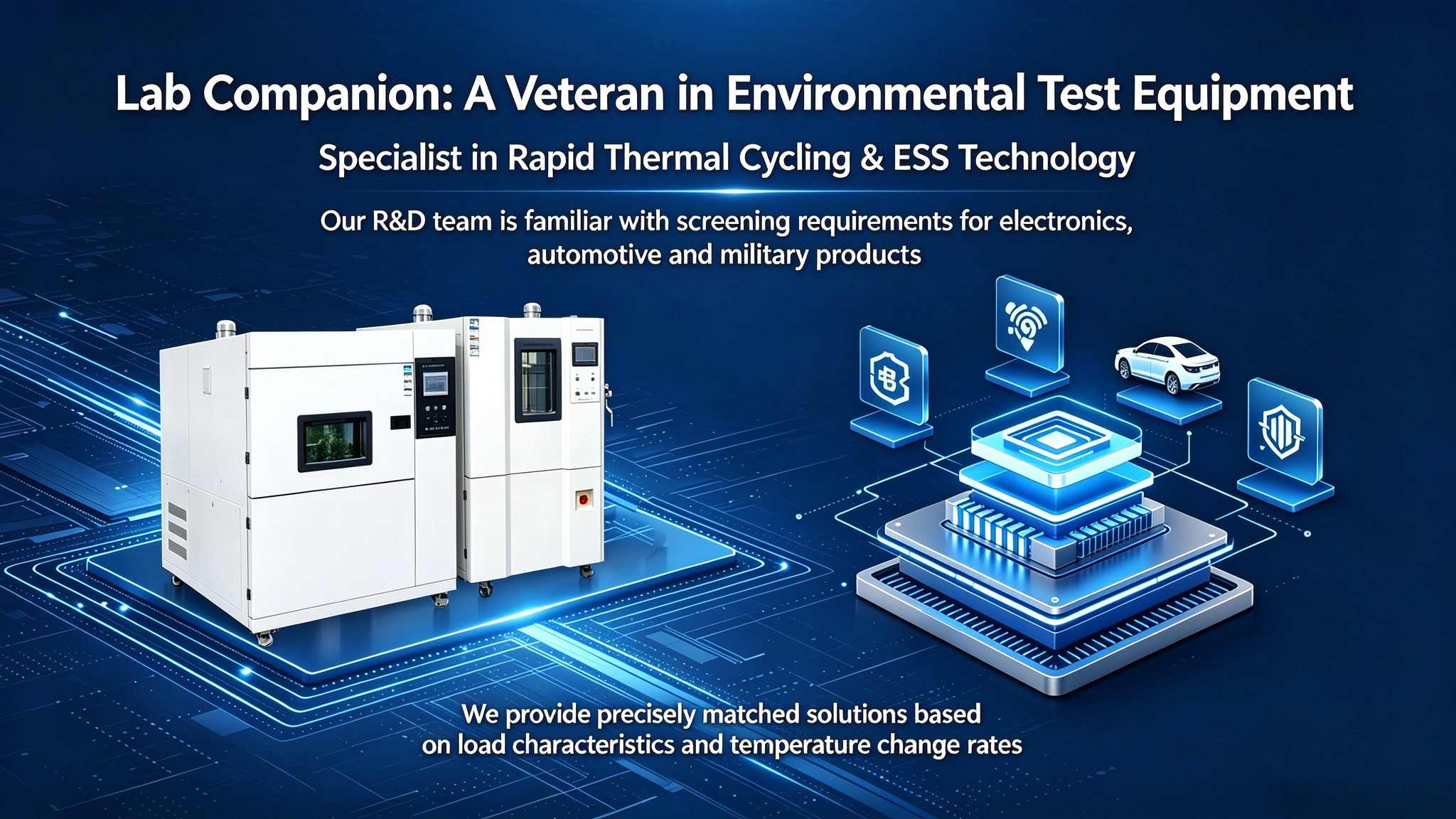
Built on a shared process backbone, Lab Companion has developed a product family centred on rapid thermal cycling chambers: the TC Series rapid thermal cycling chambers; the TH Series, which adds humidity control to the TC platform; the TS Series for extreme instantaneous thermal shock evaluation; and the ESSD Series engineered for temperature cycling of enterprise solid-state drives.
All models share identical sheet metal, refrigeration and control technologies. This allows flexible capacity allocation across product lines rather than isolated production scheduling for individual variants.
A -70°C rating is often cited as a key specification, yet stable operation at this temperature carries clear engineering barriers.
Single-stage vapour compression refrigeration suffers rapid efficiency loss at low temperatures. Below -40°C, compression ratios rise sharply, discharge temperatures climb, cooling capacity drops and long-term reliability deteriorates. Binary cascade refrigeration uses two series-connected refrigerant loops to distribute the total compression load, keeping both circuits operating within their optimal ranges.
The trade-off is greater system complexity: an extra compressor, expansion valve and intermediate heat exchanger, with a multiplied number of piping connections. The more complex the system, the more critical assembly quality becomes. Every welded joint is a potential leak point, and incomplete vacuuming leaves residual moisture that can form ice blockages at low temperatures. Stable cascade operation is therefore less a design challenge and more a challenge of assembly and in-process inspection.
Every rapid thermal cycling chamber from Lab Companion undergoes a minimum of 48 hours of uninterrupted rapid thermal cycling before shipment. This test is not merely to verify peak performance; it runs under conditions mirroring real customer operation to surface assembly-related risks before delivery.
Continuous cycling is far more demanding than a single performance run. Evaporators repeatedly frost and defrost, compressors cycle frequently, valves actuate continuously and sensors sample nonstop. Any structural weakness will emerge within this window as profile anomalies, alarms or shutdowns.
Pre-shipment metrological calibration is performed in a CNAS-accredited laboratory, with the formal calibration certificate supplied together with the unit. This means the equipment arrives with a traceable metrological baseline. For customers preparing product certifications, this reduces the need for recalibration and generates test data ready for audit submission.
Lab Companion’s TC Series covers standard internal volumes of 80 L, 150 L, 225 L, 408 L and 800 L, with customisable capacity up to 8000 L.
Standard volumes deliver shorter lead times and proven batch consistency through mass validation. Custom volumes accommodate full assemblies, modules and battery packs that exceed standard chamber dimensions.
Standard and custom units follow the same manufacturing controls, so non-standard builds are not downgraded in quality. Three constraints must be reviewed in advance for large-volume custom projects:
For procurement teams assessing whether a vendor can deliver consistently, three actionable verifications can be performed:
When purchasing environmental test equipment, buyers are ultimately investing in the assurance that the 100th unit performs identically to the first. Specifications can be compared easily, but mature manufacturing processes cannot be built quickly. This is the true value of Lab Companion’s 21 years of environmental test manufacturing experience in the mass-production era of 2026.


 Dapatkan Penawaran
 Jaringan IPv6 didukung