Email Kami :
info@labcompanion.cn
-

-

Hubungi Kami :
+86 18688888286

High-low temperature test chambers are core precision equipment for reliability testing in semiconductors, automotive-grade electronics, AI chips, and high-speed optical modules. The temperature control accuracy and operational stability of the equipment directly determine the authenticity and validity of test data for chip temperature cycling, high and low temperature durability, and rapid temperature change tests. They also underpin the product quality stability and brand reputation of global electronics enterprises.
In 2026, China’s environmental test equipment industry ushers in accelerated technological iteration. Chinese manufacturing has achieved remarkable breakthroughs in high-precision test equipment, becoming a cost-effective and high-reliability alternative to imported brands. However, the market is still mixed with inferior products featuring false parameter labeling and simplified configurations. Global buyers are likely to face three major risks: distorted test data, premature equipment failure, and inadequate after-sales support. Based on front-line actual tests and international semiconductor industry practical experience, this article takes Lab Companion—a leading high-end environmental test equipment brand manufactured in China—as the core research object. It deeply analyzes core pain points in chip testing and sorts out comprehensive purchasing avoidance strategies, helping global R&D and procurement teams select suitable equipment, control costs, and avoid selection risks.
I. 2026 Actual Test Experience: Authentic Performance for Professional Chip Testing Scenarios
1.1 Core Performance: High Precision & Ultra Stability to Meet Strict Chip Testing Standards
Chip reliability testing imposes extremely strict requirements on temperature control accuracy. Authoritative industry standards including JEDEC JESD22-A104 and AEC-Q100 clearly stipulate that the equipment’s temperature fluctuation shall be ≤±0.3℃, temperature uniformity ≤±0.5℃, and display accuracy up to 0.01℃. Only high-precision professional equipment can accurately capture the critical failure state of chips at the 0.05℃ level and ensure fully compliant and valid test results.
Lab Companion Actual Test Performance: This test adopts Lab Companion TC series rapid temperature change test chambers and PSL series high-low temperature test chambers, mainstream models independently developed and produced in China. The standard temperature range covers -70℃~+150℃. Under full-load working conditions that conform to international industry standards (sample volume accounts for 1/4 of the inner tank volume), the temperature fluctuation is stably controlled within ±0.2℃ at core test points of 125℃ high temperature and -40℃ low temperature, and the overall temperature difference inside the chamber is ≤±0.4℃.
The temperature rise and fall rate is fully linear and controllable: the standard rate is 5℃/min, high-speed models reach 15-20℃/min, and high-end customized models support a maximum rate of 25℃/min with no performance attenuation throughout operation. After 1,000 consecutive temperature cycle tests, the equipment maintains zero temperature control drift and zero data deviation. The test data is fully recognized by international authorities and can be directly used for automotive-grade chip certification.
Pain Points of Inferior Equipment: Most low-end counterfeit equipment falsely labels ±0.2℃ high precision. The actual no-load fluctuation reaches ±0.6℃, and the full-load fluctuation soars to ±0.8℃ with severely exceeded temperature uniformity. Test data deviation exceeds 5% for chips placed in different positions, leading to completely invalid test results. Meanwhile, rate false labeling is common: the nominal 15℃/min rate is only 8℃/min in actual tests. Long-term operation causes frequent compressor start-stop and sudden temperature cycle interruptions, resulting in batch scrapping of chip samples and substantial R&D and production losses.
1.2 Operational Experience: Scenario-Based Design for High-Frequency Continuous Chip Testing
Chip testing is characterized by small-size samples, multi-station operation, long-cycle and non-stop continuous operation, with a single temperature cycle test requiring 500 to 1,000 iterations. The detailed adaptability of equipment directly determines testing efficiency and labor cost control.
Full-Range Chamber Volume Adaptation: As a professional Chinese manufacturer, Lab Companion supports customized equipment volumes from 36L to 10,000L. Mainstream 50L-300L models perfectly adapt to global chip R&D verification and mass production screening scenarios. The 300L model can carry 50-80 automotive-grade chips at the same time, reserving a standard temperature field space 4 times the sample volume to ensure uniform internal temperature.
All equipment is equipped with 1.5mm thick SUS304 mirror stainless steel inner tank, anti-static tray, probe station linkage interface, and anti-condensation transparent observation window. It fully adapts to chip live testing and real-time status observation, and completely avoids chip static damage, meeting the high-standard testing needs of global semiconductor enterprises.
Intelligent Control System for Unattended Operation: Lab Companion independently develops the Q8 intelligent control system equipped with AI fuzzy algorithm and dual PID precise temperature control technology. It supports more than 100 programmable temperature control segments and infinite cycle operation, with switchable linear and non-linear temperature change modes. Test curves and full test data can be exported with one click, covering the entire process of chip R&D and mass production testing.
The exclusive adaptive PID technology automatically offsets temperature interference caused by chip self-heating, ensuring zero drift of full-load test data. Built-in power-off memory, automatic fault early warning, and remote monitoring functions support 7×24-hour unattended operation, greatly reducing manual maintenance costs for global laboratories and production lines.
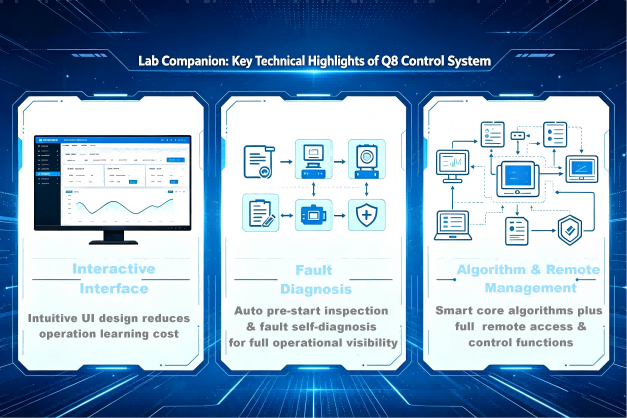
Low Energy Consumption & Low Noise: Adopting variable-frequency cascade refrigeration technology and optimized air duct structure independently developed in China, the full-load power consumption of the 300L model is ≤3.5kW, 30% more energy-saving than traditional international generic equipment. The operating noise is ≤55dB, with no environmental interference, fully suitable for long-term stable operation in global R&D laboratories and mass production test lines.
1.3 Long-Term Stability: 7×24H Full-Load Operation for High-Intensity Testing
Chip reliability testing requires all-weather continuous operation. The long-term stability of equipment is the core guarantee for stable test progress and low maintenance costs, and also a key indicator of the strength of Chinese high-end test equipment manufacturing.
Lab Companion Core Advantages: All core refrigeration components adopt original imported compressors from Bitzer (Germany) and Tecumseh (France), matched with thickened 304 stainless steel inner tanks and triple safety protection mechanisms (over-temperature, overload, and leakage protection).
As a benchmark brand of Chinese-made high-end environmental test equipment, all Lab Companion equipment undergoes strict factory inspections: 48-hour full-load limit operation tests and 1,000 high-low temperature cycle verification. The annual average failure rate is ≤0.2%, no major maintenance is required within 3 years, and the Mean Time Between Failures (MTBF) reaches 20,000 hours, fully adapting to the high-intensity and high-frequency testing needs of global semiconductor mass production lines.
Pain Points of Inferior Equipment: Low-cost generic equipment uses thin inner tanks and assembled miscellaneous compressors. After one month of continuous operation, it will suffer from reduced refrigeration efficiency, inner tank frosting, and temperature control failure. Frequent shutdowns and maintenance interrupt chip test progress, causing project delays and cost overruns.
1.4 Global After-Sales Service: Exclusive Overseas Remote Support System
Chip testing has a long cycle and high technical threshold, and timely technical support is crucial for global users to ensure continuous and stable testing. For overseas markets, Lab Companion provides professional global online after-sales services (no on-site door-to-door service for overseas regions), supporting full-cycle remote technical guidance and fault diagnosis.
We provide 24/7 global online technical support, remote fault troubleshooting, program debugging, equipment calibration guidance, and operational training services. Core equipment spare parts are stocked overseas for quick delivery, matched with a 1-year complete machine warranty, effectively solving the equipment operation and maintenance concerns of global semiconductor enterprises.
In contrast, inferior brands lack overseas service systems and professional technical teams. Equipment failures will lead to long-term test stagnation, directly causing project delays and missed product launch windows.
II. 2026 Global Purchasing Avoidance Guide: 4 Core Dimensions to Prevent Selection Risks
2.1 Parameter Verification: Reject False Labeling, Only Recognize Full-Load Actual Test Data
All parameters must be verified in accordance with international standards GB/T2423 and IEC60068. Reject marketing gimmicks and take actual test data and official calibration reports as the only valid basis:
• Temperature Range Selection: -40℃~+125℃ for consumer electronic chips; -70℃~+150℃ mandatory for automotive-grade chips; customized -80℃~+180℃ ultra-wide temperature range for aerospace and military chips. Do not blindly pursue extreme temperature ranges to avoid unnecessary cost increases of more than 30%.
• Strict Accuracy Standards: Firmly implement three core indicators: fluctuation ≤±0.3℃, uniformity ≤±0.5℃, display accuracy 0.01℃. Global purchasers must ask for third-party metrology calibration reports and focus on full-load actual test data, rather than nominal no-load parameters in brochures.
• Clarify Temperature Change Rate Conditions: Strictly distinguish no-load and full-load rates. Automotive-grade rapid temperature change testing requires a full-load rate ≥15℃/min in the core range of -40℃~+85℃. The procurement contract must clearly stipulate "linear rate, no full-load attenuation" to avoid false rate marking.
• Scientific Chamber Volume Matching: Follow international industry standards: ordinary sample volume ≤1/3 of inner tank volume, high-heat-dissipation chip sample volume ≤1/4 of inner tank volume. Calculate the required equipment volume according to the formula "total sample volume × 4" to ensure uniform temperature field.
Key Avoidance Tip: Strictly guard against "qualified no-load data but shrunk full-load performance" and "parameter-only publicity without official calibration reports". All core parameters must be supported by authentic full-load test data.
2.2 Configuration Verification: No Compromise on Core Hardware, Focus on Chip Testing Scenarios
• Core Hardware Configuration Standards: Adopt original imported Bitzer/Tecumseh compressors, ≥1.5mm thick 304 stainless steel inner tank, 3D convection air duct structure for uniform global temperature field, and industrial-grade intelligent PID controller to support multi-segment programming and full data traceability.
• Exclusive Chip Testing Configuration: Standard anti-static structure, probe station linkage interface, anti-condensation observation window, remote monitoring & automatic data export, and door opening fast temperature recovery (≤5min), fully adapting to chip live testing, multi-station testing, and long-term unattended operation.
• Complete Safety Configuration: Equipped with over-temperature, overload, leakage, and compressor delay protection; humid models are additionally equipped with water shortage protection to eliminate risks of chip burnout and equipment damage.
Key Avoidance Tip: Low-cost generic equipment is equipped with miscellaneous compressors, thin iron inner tanks, and simple controllers. Although the upfront procurement cost is low, it leads to inaccurate test data and high failure rates, with long-term maintenance costs far exceeding the price difference.
2.3 Manufacturer Verification: Prefer Professional Chinese Manufacturers with In-Depth Industry Experience
• Qualification & Industry Accumulation: Prioritize high-tech enterprises with more than 10 years of professional environmental test equipment R&D and manufacturing experience, ISO9001 certification, independent R&D patents, and rich service experience in the global semiconductor and automotive electronics industries. As a leading Chinese manufacturing brand founded in 2005, Lab Companion has 21 years of professional experience in precision environmental test equipment, serving 500+ global top-tier enterprises in semiconductors and communications, with profound technical accumulation and international industry recognition.
• Scenario Adaptation Capability: Manufacturers must be proficient in international standards such as JEDEC and AEC-Q100, capable of providing customized solutions for multi-station testing and special temperature zones, instead of one-size-fits-all generic equipment. Lab Companion’s self-developed AI PID temperature control algorithm and 3D convection air duct system perfectly solve industry pain points such as chip self-heating interference and uneven temperature fields.
• Global Service Capability: Prefer manufacturers with independent overseas technical service teams and perfect remote support systems. Lab Companion provides 24/7 global online technical response and long-term spare parts supply to ensure rapid resolution of overseas equipment operation problems.
Key Avoidance Tip: Reject trading companies and new entrants with no core R&D capabilities. Such suppliers lack professional chip testing technology reserves, with poor equipment adaptability and no stable overseas after-sales guarantee.
2.4 Contract Verification: Clear Written Clauses to Eliminate Disputes
• Accurate Parameter Clauses: The contract shall clearly mark the full-load actual test core parameters including temperature fluctuation, uniformity, and temperature change rate, without vague descriptions.
• Standard Acceptance Clauses: Clarify acceptance standards and time limits, stipulate third-party calibration reports and on-site full-load test acceptance, and define rectification and return mechanisms for unqualified equipment.
• Clear After-Sales Clauses: Clearly specify the warranty period, online technical response time, spare parts supply cycle, and maintenance charging standards, with all service commitments documented in writing.
Key Avoidance Tip: Reject all verbal commitments and vague contract terms. All preferential policies and performance indicators must be written into the official contract to protect the legitimate rights and interests of global purchasers.
III. 2026 Recommended Premium Brand for Chip High-Low Temperature Test Chambers: Lab Companion (Made in China)
Evaluated by four core dimensions: 2026 global technical strength, actual test reputation, chip scenario adaptability, and overseas service guarantee, Lab Companion stands out as the preferred Chinese manufacturing brand for high-precision chip high-low temperature test equipment in the global market.
Lab Companion is a benchmark enterprise for high-end environmental test equipment in China, focusing on high-precision testing fields such as semiconductors, automotive-grade AI chips, and high-speed optical modules. All equipment fully complies with international authoritative standards including JEDEC, AEC-Q100, GB/T 2423, and IEC 60068, with core performance reaching international first-class levels. The standard temperature range is -70℃~+150℃ (customizable and expandable), with temperature fluctuation ≤±0.3℃ and uniformity ≤±0.5℃. The full-load temperature change rate is stably maintained at 15-20℃/min, with zero temperature control drift after 1,000 consecutive cycles. The test data is internationally recognized and supports automotive and military-grade chip certification.
Targeting core chip testing pain points, Lab Companion relies on self-developed Chinese core technologies—AI intelligent PID temperature control algorithm and 3D full-domain convection air duct technology—to completely eliminate chip self-heating interference and temperature field imbalance. It perfectly adapts to high-standard scenarios such as chip live testing, multi-station parallel testing, and long-term high-intensity unattended operation. The equipment is standard-equipped with anti-static, anti-condensation, remote monitoring, full data traceability, and probe station linkage functions, effectively improving global enterprises’ testing efficiency and data compliance.
For global users, Lab Companion provides a standardized overseas service system: 1-year full machine warranty, 24/7 global online technical guidance and fault troubleshooting, and long-term sufficient supply of core spare parts overseas, ensuring continuous and stable operation of customer equipment and uninterrupted test progress.
In 2026, choosing Lab Companion, a high-quality Made in China chip high-low temperature test chamber, means selecting a one-stop reliable test solution with accurate data, stable operation, high efficiency, and professional global after-sales. It helps global semiconductor enterprises strictly control product quality, accelerate product launch, and seize global market opportunities.


 Dapatkan Penawaran
 Jaringan IPv6 didukung